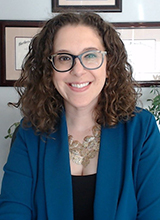
Thank you for your interest in learning more about me! My name is Dr. Ruth Varkovitzky (she/her) and I am a licensed clinical psychologist. I use a culturally sensitive evidence based approach in my clinical work; combining the best science while tailoring therapy to each individual. In the spirit of providing the highest quality of care possible, I am board certified in Behavioral and Cognitive Psychology by the American Board of Professional Psychology.
I specialize in providing therapy for trauma and sleep disorders, such as PTSD and insomnia. In addition, I offer a variety of treatments to address problems with depression, anxiety, and OCD. Supporting folks with these challenges is my passion; it’s an honor to work alongside my clients and see them heal and grow.
Public service has always been part of my journey, including collaboration with shelters for survivors of domestic violence, the Department of Veterans Affairs, the University of Washington Department of Psychiatry and Behavioral Sciences, and the Washington State Board of Psychologist Examiners. In addition to my passion for clinical work, I’ve enjoyed contributing to psychological science through academic and media publications. I established my private practice Renewal Psychology to offer my services to clients in Washington as well as the many state members of the Psychology Interjurisdictional Compact (PSYPACT).
I welcome being connected! Please reach out to me by email at: drruth@renewalpsych.com.
Personal Statement
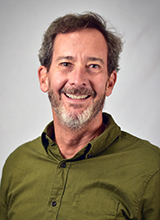
I am a clinical psychologist and mental health services researcher. My overarching research aim is to produce and promote use of research, evaluation, and continuous quality improvement that aids high-quality implementation of effective models of care in real world service settings, such as in schools, public mental health systems, and family-and youth-run organizations. My research can be summarized as falling into three categories: (1) Care coordination models for youth with the most complex behavioral health needs; (2) school mental health; and (3) public sector implementation of research-based practices. In each area, I co-direct national training and TA centers. For example the National Wraparound Implementation Center (www.nwic.org), provides support to dozens of states and localities internationally on Wraparound. The National Wraparound Initiative (www.pdx.edu) serves to mobilize our research and policy activities. Our Wraparound fidelity tools and data systems can be found at www.wrapinfo.org. With respect to school mental health, our interdisciplinary UW School Mental Health Assessment, Research, and Training (SMART) Center — www.smartcenter.uw.edu — currently has over a dozen federal grants as well as state, local, and foundation funding focused on how best to ensure that evidence for effective mental health intervention and prevention is translated into effective programming in schools. The SMART Center also hosts the school mental health supplement of the UW Department of Psychiatry’s SAMHSA-funded Northwest Mental Health Training and Technical Assistance Center (MHTTC). Check out our extraordinary array of resources at https://mhttcnetwork.org/centers/northwest-mhttc/northwest-mhttc-school-mental-health.
Personal Statement
Over the past 20 years, my research has focused on the genetics of schizophrenia and neurodegenerative disorders, particularly on the use of clinical phenotyping and innovative genomic technologies to elucidate the complex genetic architecture underlying schizophrenia and Alzheimer’s disease (AD). I served as the Director of the Geriatric Research, Education, and Clinical Center (GRECC) at the VA Puget Sound Health (VAPS) from 2011-2022, in order to focus on my research on Alzheimer’s Disease and related disorders. My current research interests are two-pronged: 1) develop machine learning models in VA’s vast electronic health records in order to assign ADRD probability scores in older Black and White Veterans; and 2) use mobile health devices to promote early diagnosis of dementia with Lewy bodies. In In these capacities, I direct multidisciplinary efforts to better understand the biology, genetics, etiology, prevention, and treatment of these disorders, and I provide clinical expertise for the differential diagnosis of neurodegenerative disorders and treatment of behavioral disturbances in dementias.

Personal Statement
Myra Parker, JD, PhD is an Associate Professor of Psychiatry and Behavioral Sciences, and Director of Seven Directions: A Center for Indigenous Public Health, based within the Center for the Study of Health and Risk Behaviors, University of Washington. She received her doctorate in Health Services at UW School of Public Health, and has been a member of the faculty since 2014.
Dr. Parker’s research and clinical interests include: (1) cultural adaptation of alcohol and drug interventions among American Indians and Alaska Natives (with a particular focus on tribal college drinking harm reduction), (2) development and testing of parenting interventions to support early childhood development in American Indian and Alaska Native communities, (3) co-morbidity of substance use with depression, suicide, trauma, and PTSD, (4) research capacity development, including ethical aspects of research, for tribal and urban Indian communities; and, (5) dissemination and translation of evidence-based prevention and intervention approaches at the individual, institutional, and community level, including policy development. She has worked with tribal and urban Indian communities across the United States on these topics.

Personal Statement
I am a Professor in the Department of Psychiatry and Behavioral Sciences at the University of Washington and licensed Clinical Psychologist who specializes in development and evaluation of technology-based approaches in the study, assessment, treatment, and prevention of mental illness. This work includes development of illness self-management apps for people with schizophrenia, texting interventions, behavioral sensing/digital phenotyping, computational psychiatry/predictive modelling, applications of Natural Language Processing (NLP), and development of culturally-relevant digital mental health resources for communities in low-and-middle-income countries.
My research has been supported by grants and awards from the National Institutes of Health (NIH), National Science Foundation (NSF), Center for Medicare and Medicaid Innovation (CMMI) Patient Centered Outcomes Research Institute (PCORI), SYNERGY Clinical and Translational Science Institute, Myrtlewood Foundation, and John Sloan Dickey Center for International Understanding. I publish extensively in scientific journals and am a regular speaker at national and international scientific meetings including invited presentations at the White House and National Institute of Mental Health Director’s Innovation Speaker series. I have written editorials and commentaries on the use of technology-based interventions for Psychiatric Services, the BMJ, and the New York Times, and my research has been covered by Public Radio, Nature, Wired Magazine, Slate, and The Economist. I served on the Editorial Board of Schizophrenia Bulletin and am the Inaugural Editor of the “Technology in Mental Health” Column for Psychiatric Services (APA journal).
Personal Statement
I am a perinatal psychiatrist and Associate Professor in the Department of Psychiatry and Behavioral Sciences.
I earned my medical degree from Bangalore Medical College, India, and completed a psychiatry residency in St. John’s Medical College, India. I completed a second residency in Psychiatry with a focus on women’s mental health and integrated care from the University of Washington, and a fellowship in Primary Care in Psychiatry.
I also earned a Master’s in Public Health from the University of Washington School of Public Health. I am board certified with the American Board of Psychiatry and Neurology.
Personal Statement
James Basinski is an assistant clinical professor at Harborview Medical Center where he works at both the Psychiatric Intensive Care Unit as well as the Health Care for the Homeless program at the Third Avenue Clinic. He graduated from the University of Pittsburgh Medical School, and then moved to Seattle where he completed his psychiatry residency at the University of Washington and served as chief resident at Harborview Medical Center. He currently an advanced clinical associate the Seattle Psychoanalytic Society and Institute. He also maintains a private practice in Seattle delivering medication management and psychotherapy services
Personal Statement
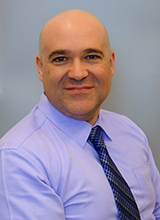
I am a licensed clinical psychologist in Washington State. I am the Director of the University of Washington School of Medicine’s Psychology Internship Program which is accredited by the American Psychological Association’s Office of Program Consultation and Accreditation. And, I conduct research on health and risk behaviors across the lifespan. Specifically, I have conducted research in the areas of college student alcohol use, young adult gambling behavior, and co-morbidity of substance use and mental health/risk behaviors (i.e. risky sexual behaviors). I have extensive experience working with college students/young adults, military/veteran, and minority/diverse populations. I am also interested in mental health issues including depression, anxiety, and PTSD. I maintain an active clinical practice in the areas of mental health issues with patients diagnosed with hematological and oncological illness and have clinical responsibilities at the Fred Hutchinson Cancer Center. I also provide clinical supervision for psychology residents and psychology practicum students at Fred Hutchinson Cancer Center as well. Overall, my professional aspirations are to improve the public health through empirically-supported psychological interventions and providing mentorship to diverse trainees to expand the reach of psychology.
Personal Statement
I am a national expert on collaborative care and specifically, on training teams to implement and deliver mental health treatment in primary care settings. My passion for translating complex research ideas into practical real-world applications began when I received my MD and PhD in Anatomy and Neurobiology as part of the Medical Scientist Training Program at the University of California at Irvine.
I am currently a Professor in the Department of Psychiatry and Behavioral Sciences at the University of Washington where I have developed additional expertise in suicide prevention training, mental health workforce development, adult learning best practices, and mentorship. I am the Co-Director of the AIMS Center (Advancing Integrated Mental Health Solutions) and Director of the UW Integrated Care Training Program for residents and fellows.