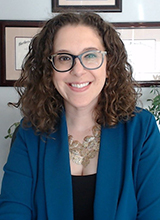
Thank you for your interest in learning more about me! My name is Dr. Ruth Varkovitzky (she/her) and I am a licensed clinical psychologist. I use a culturally sensitive evidence based approach in my clinical work; combining the best science while tailoring therapy to each individual. In the spirit of providing the highest quality of care possible, I am board certified in Behavioral and Cognitive Psychology by the American Board of Professional Psychology.
I specialize in providing therapy for trauma and sleep disorders, such as PTSD and insomnia. In addition, I offer a variety of treatments to address problems with depression, anxiety, and OCD. Supporting folks with these challenges is my passion; it’s an honor to work alongside my clients and see them heal and grow.
Public service has always been part of my journey, including collaboration with shelters for survivors of domestic violence, the Department of Veterans Affairs, the University of Washington Department of Psychiatry and Behavioral Sciences, and the Washington State Board of Psychologist Examiners. In addition to my passion for clinical work, I’ve enjoyed contributing to psychological science through academic and media publications. I established my private practice Renewal Psychology to offer my services to clients in Washington as well as the many state members of the Psychology Interjurisdictional Compact (PSYPACT).
I welcome being connected! Please reach out to me by email at: drruth@renewalpsych.com.
I am a clinical psychologist at Seattle Children’s Hospital and UW Medicine, where my work primarily consists of clinical care and teaching. My two areas of focus are the provision of effective, trauma-informed treatment for youth and families in suicidal crises and the promotion of equitable access to behavioral healthcare.
Personal Statement
I am a clinical psychologist and mental health services researcher. My overarching research aim is to produce and promote use of research, evaluation, and continuous quality improvement that aids high-quality implementation of effective models of care in real world service settings, such as in schools, public mental health systems, and family-and youth-run organizations. My research can be summarized as falling into three categories: (1) Care coordination models for youth with the most complex behavioral health needs; (2) school mental health; and (3) public sector implementation of research-based practices. In each area, I co-direct national training and TA centers. For example the National Wraparound Implementation Center (www.nwic.org), provides support to dozens of states and localities internationally on Wraparound. The National Wraparound Initiative (www.pdx.edu) serves to mobilize our research and policy activities. Our Wraparound fidelity tools and data systems can be found at www.wrapinfo.org. With respect to school mental health, our interdisciplinary UW School Mental Health Assessment, Research, and Training (SMART) Center — www.smartcenter.uw.edu — currently has over a dozen federal grants as well as state, local, and foundation funding focused on how best to ensure that evidence for effective mental health intervention and prevention is translated into effective programming in schools. The SMART Center also hosts the school mental health supplement of the UW Department of Psychiatry’s SAMHSA-funded Northwest Mental Health Training and Technical Assistance Center (MHTTC). Check out our extraordinary array of resources at https://mhttcnetwork.org/centers/northwest-mhttc/northwest-mhttc-school-mental-health.
Personal Statement
Over the past 20 years, my research has focused on the genetics of schizophrenia and neurodegenerative disorders, particularly on the use of clinical phenotyping and innovative genomic technologies to elucidate the complex genetic architecture underlying schizophrenia and Alzheimer’s disease (AD). I served as the Director of the Geriatric Research, Education, and Clinical Center (GRECC) at the VA Puget Sound Health (VAPS) from 2011-2022, in order to focus on my research on Alzheimer’s Disease and related disorders. My current research interests are two-pronged: 1) develop machine learning models in VA’s vast electronic health records in order to assign ADRD probability scores in older Black and White Veterans; and 2) use mobile health devices to promote early diagnosis of dementia with Lewy bodies. In In these capacities, I direct multidisciplinary efforts to better understand the biology, genetics, etiology, prevention, and treatment of these disorders, and I provide clinical expertise for the differential diagnosis of neurodegenerative disorders and treatment of behavioral disturbances in dementias.
Personal Statement
I am an Assistant Professor in the Department of Psychiatry & Behavioral Sciences at the University of Washington Medical Center. In addition to general psychiatry, I am an expert in Consultation Liaison Psychiatry. My primary clinical roles are in the inpatient psychiatry consultation service at the University of Washington Medical Center and Harborview Medical Center.
I earned my bachelor’s degree from the University of California, Berkeley and his M.D. from Loma Linda University in California. I first came to the UW as a psychiatry resident, and then continued on for my fellowship in Psychosomatic Medicine.
Personal Statement
I am Medical Director of Inpatient and Acute Mental Health Services at Seattle Children’s Hospital, where I provide clinical leadership and clinical care to patients with a broad range of diagnoses and presenting concerns in the Psychiatry and Behavioral Medicine Unit, Partial Hospitalization Program, and Emergency Department Mental Health program. I aim to provide high quality, family-focused, evidence-based care as part of a multidisciplinary team. I am highly involved in educating residents, fellows, and medical students, and serve as Associate Training Director for Inpatient Psychiatry for the child psychiatry fellowship program.
Personal Statement
I came to the UW to train in psychosomatic medicine and to work in a complex comorbid population as a clinician and a teacher. Most medical and surgical patients served at Harborview will have psychosocial needs; often these are as critical to their recovery and health as somatic health problems. Working across disciplines is challenging but also clinically valuable, intellectually stimulating, and exciting to our trainees when we can address care in a more integrated and holistic manner. I like to focus my academic work on defining what the needs of Harborview’s clinical population are, and how our busy psychiatric consultation services can be best utilized to promote the health of our patients and our institutions.
Personal Statement
My work focuses on the diagnosis and treatment of ADHD in adolescents and adults. As part of this work I conduct clinical trials evaluating school, community, and parent based treatments for teens with in attention, motivation, and executive function challenges. I also am an investigator on several longitudinal studies of ADHD, including the Multimodal Treatment of ADHD (MTA) study. I have authored or co-authored over 120 scientific papers on ADHD and wrote a book about how parents and professionals can empower teenagers with ADHD.
I also specialize in the application of Motivational Interviewing approaches to the treatment of ADHD and am a member of the Motivational Interviewing Network of Trainers (MINT). This for includes training clinicians in strategies to adapt psychotherapeutic and pharmacological treatment for patients with ADHD, to improve treatment engagement.
My research has been funded by the National Institute of Mental Health, Institute of Education Sciences, American Psychological Foundation, and Klingenstein Third Generation Foundation, I am actively involved in Children and Adults with Attention Deficit Hyperactivity Disorder (CHADD), serving on its professional advisory board, spokesperson team, and editorial advisory board for Attention Magazine. I currently serve as the Secretary of the American Professional Society of ADHD and Related Disorders, and am a member of the APSARD Adult ADHD Guidelines Task-Force.
For full information about my work, please see my
professional website.